Last month I handed my class a shape that was half rectangle, half curve. A boy named David ran his ruler along the two straight sides, scribbled down 32 cm, and closed his workbook, certain he'd found the perimeter. He'd measured everything with a straight edge except the one edge that wasn't straight.
That's the thing about perimeter. It looks like simple addition until a shape rounds off, and students either freeze or pretend the curve isn't there.
David wasn't being lazy. He just didn't know what to do with an edge his ruler couldn't lie flat against.
Perimeter, One Shape at a Time
Perimeter is nothing more than the total distance around the outside of a shape. For plane figures you've already met, that distance follows a short list of rules, and once those rules are automatic, composite shapes stop being scary.
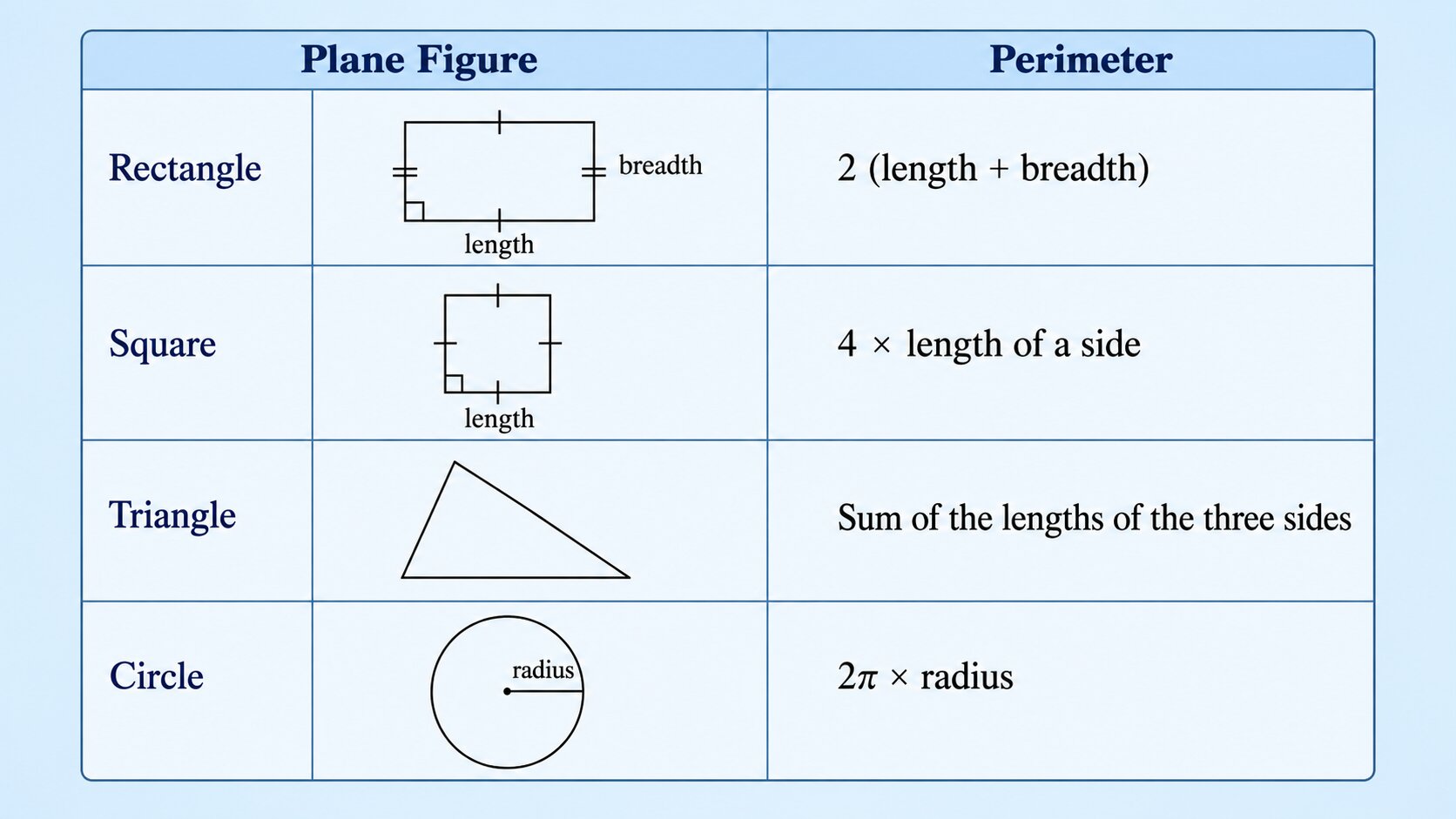
A rectangle's boundary is just twice the length plus twice the breadth, which is why the formula reads 2(length + breadth). A square is a rectangle where every side matches, so you can shortcut straight to 4 × side. A triangle has no shortcut at all: you add whatever the three sides happen to be.
A circle's boundary is its circumference, 2πr, and that one constant, π, is doing all the work.
Advertisement
Plenty of real shapes aren't full circles though. A window arch, a grill, a cut lamina: each of these gives you a slice of a circle instead of the whole thing, and that slice is called a sector.
When the Edge Curves
Take a semicircle. Its centre angle is 180°, which is 1/2 of a full 360° turn. So the curved edge of a semicircle, its arc length, must be 1/2 of the full circle's circumference: arc length = 1/2 × 2πr = πr.
A quarter circle, called a quadrant, works the same way. Its centre angle is 90°, which is 1/4 of 360°, so its arc length is 1/4 × 2πr = πr/2.
Stretch that pattern to any angle θ at the centre and you get one formula that covers every sector: arc length = θ/360 × 2πr. Whatever fraction of the full turn the angle represents, that same fraction of the circumference is your arc.
Now Let's Measure Four Shapes
Example 1
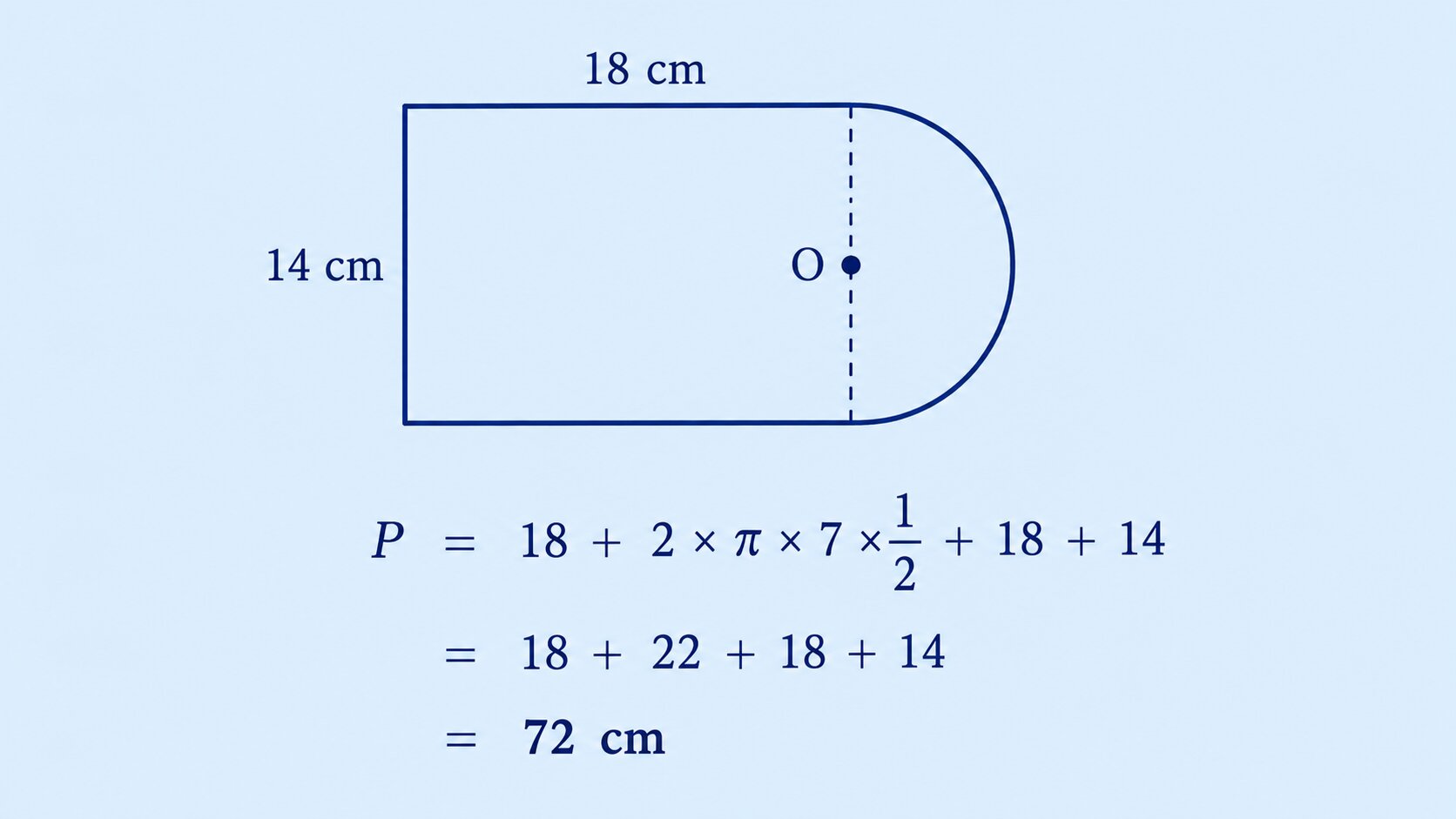
This shape keeps three straight sides of the rectangle and swaps the fourth for a semicircular bulge. The top and bottom each run 18 cm, the left side runs 14 cm, and that leaves the curved edge: a semicircle with diameter 14 cm, so radius 7 cm.
Its arc length is πr = 22/7 × 7 = 22 cm. Add the three straight pieces and the arc together: 18 + 14 + 18 + 22 = 72 cm.
Example 2
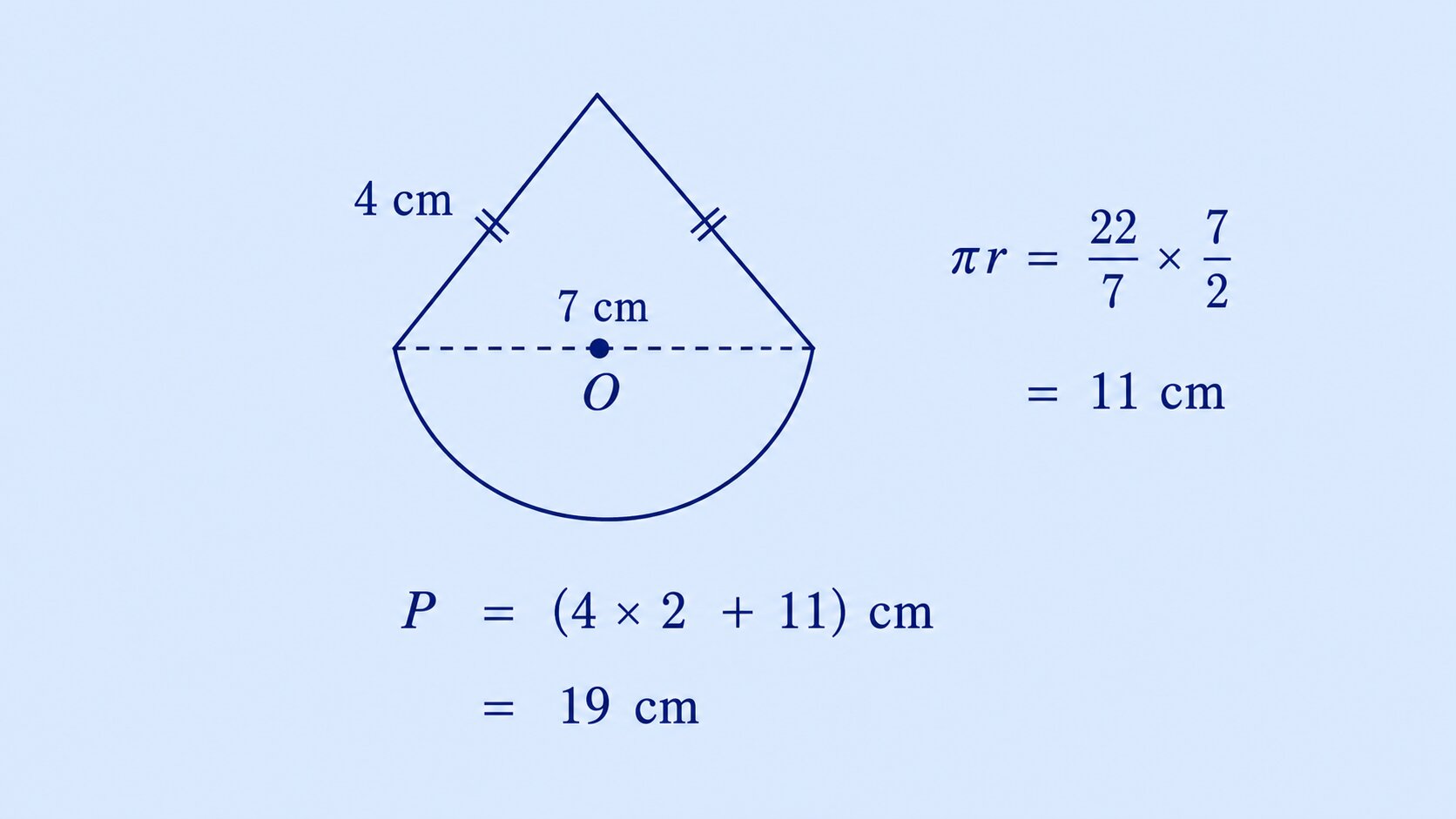
Notice the two slanted sides are marked equal, both 4 cm, so there's no measuring trick needed there. The base of this raindrop shape isn't a straight line either, it's a semicircle with diameter 7 cm, giving radius 3.5 cm.
Its arc length is πr = 22/7 × 3.5 = 11 cm. Add the two slanted sides and the arc: 4 + 4 + 11 = 19 cm.
Advertisement
Example 3
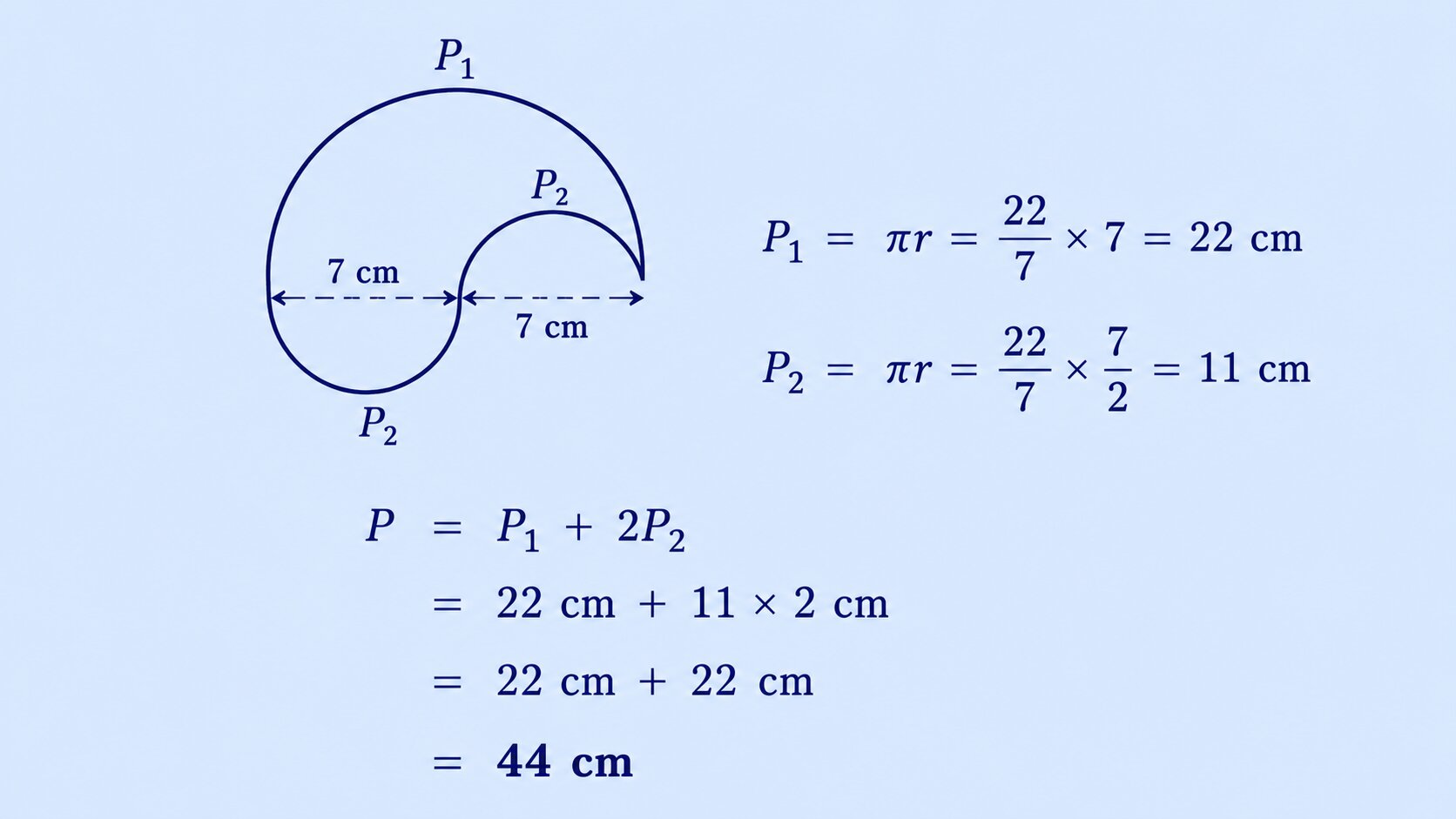
Here the whole question is just the arc, no straight edges to add at all. The centre angle of a semicircle is always 180°, so plug r = 7 cm straight into arc length = πr.
πr = 22/7 × 7 = 22 cm.
Small semicircle looks almost identical to the last one, except the 7 cm given this time is the diameter, not the radius. radius = 3.5 cm.
Then the same rule applies: arc length = πr = 22/7 × 3.5 = 11 cm.
Every edge of the shaded region is now a curve: 22 + 11 + 11 = 44 cm.
Example 4
A portion of a grill to be fixed to a window has been made by combining two equal sectors of circles as shown in the figure. The person making the grill states that based on the given data, a wire of length 128 cm is required for it
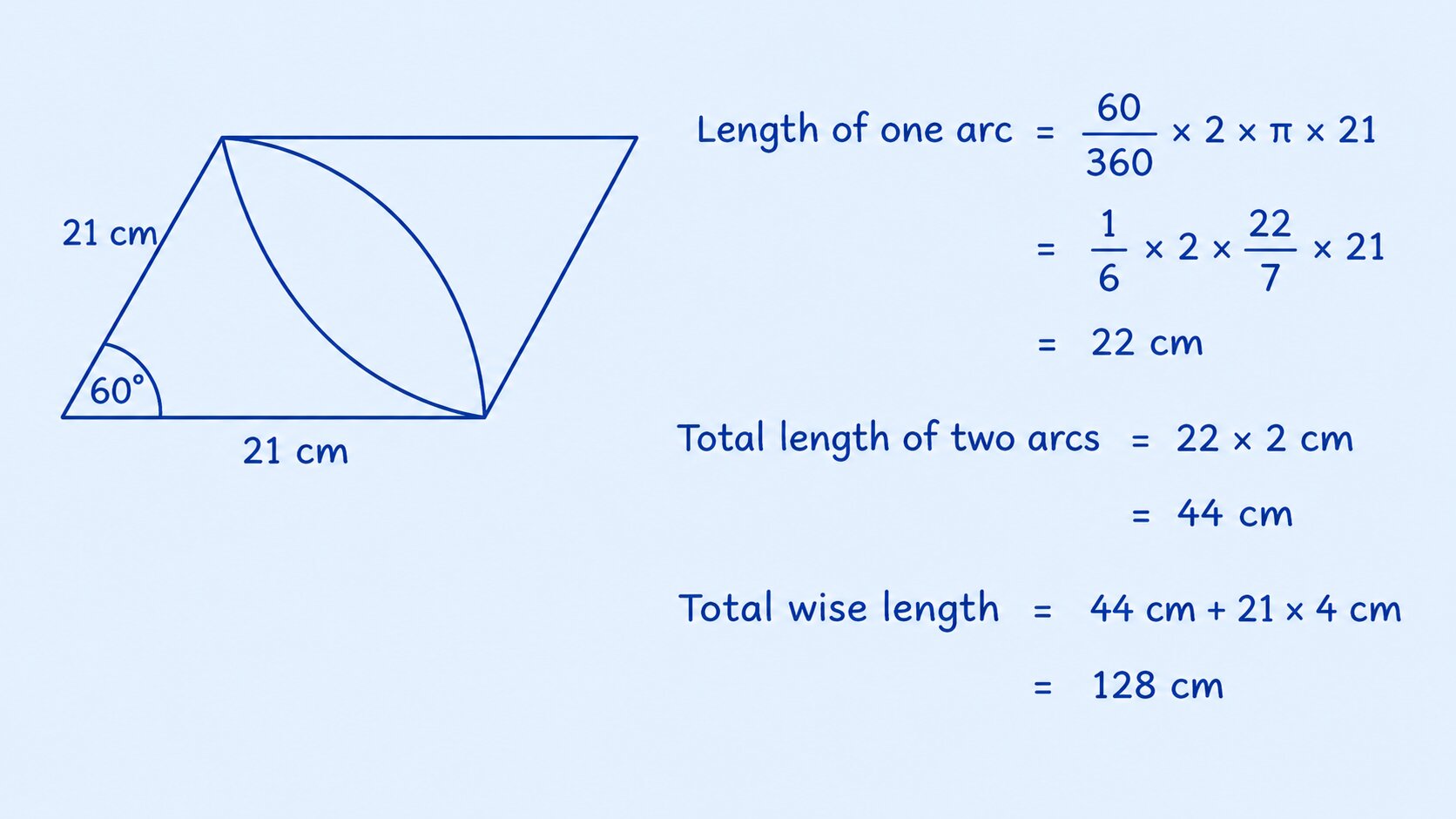
A grill maker claimed this frame needs 128 cm of wire, and the fastest way to check him is to add up every edge separately. The outer rhombus has four sides of 21 cm each, so its boundary alone is 4 × 21 = 84 cm.
Inside, two equal sectors trace the lens shape, each with radius 21 cm and centre angle 60°. One arc's length is 60/360 × 2π × 21 = 1/6 × 132 = 22 cm, so both arcs together add 44 cm.
Total wire needed: 84 + 44 = 128 cm. The grill maker was right.
That's really the whole trick behind perimeter once curves get involved: straight sides still just get added, and every curved piece is a fraction of some circle's circumference waiting to be worked out.David's rectangle-with-a-bulge would take him thirty seconds now, curve included. Keep that ruler moving all the way around, even where it doesn't want to lie flat.